martes, 22 de noviembre de 2016


                            PRESENT PROGRESSIVE OR CONTINUOUS

The present progressive puts emphasis on the course or duration of an action.
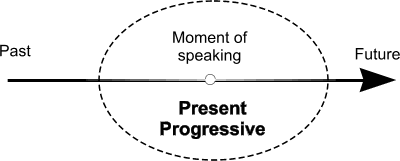
Time line

The present progressive is used for actions going on in the moment of speaking and for actions taking place only for a short period of time. It is also used to express development and actions that are arranged for the near future.
Present progressive is also known as present continuous.
Use a form of to be and the infinite verb plus -ing.
Use:
  • am with the personal pronoun I
  • is with the personal pronouns heshe or it (or the singular form of nouns)
  • are with the personal pronouns youwethey (or the plural form of nouns)

affirmative                               negative                                            question

am playing.                      I am not playing.                                Am I playing?
He is playing.                     He is not playing.                                 Is he playing?
You are playing.                 You are not playing.                        Are you playing?


In negative sentences, we put not between the form of be and the verb.
In questions, we simply swop the places of subject and the form of be.

jueves, 10 de noviembre de 2016


Hello Guys:  These are the videos that we watched in the class. Use them to improve your oral presentation. I am sure you will do it very well!


miércoles, 5 de octubre de 2016


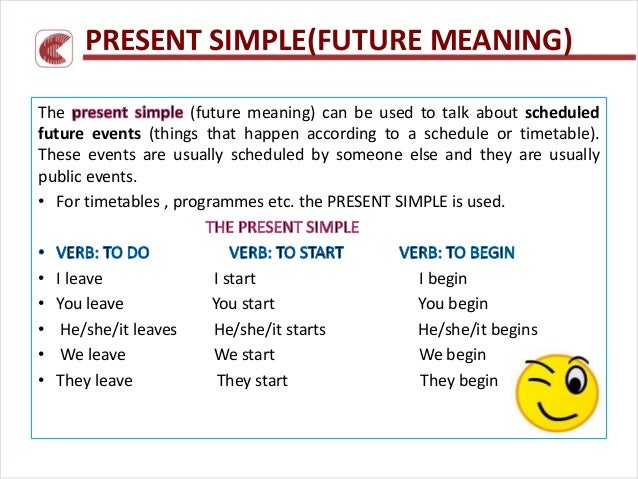
SIMPLE PRESENT FOR FUTURE EVENTS


The present simple can be used to talk about talk about scheduled future events. 
These are events that happen according to a schedule or timetable. They are usually scheduled by someone else and they are usually public events.


Tomorrow is Friday.

I fly to Paris next week.

The plane departs at 8 p.m.

The train to Ottawa leaves at 11:30 a.m.

When do you leave for NYC?

Her train arrives at 8:35 a.m. tomorrow morning.

What time does the movie start tonight?

What time do you finish work tomorrow?

What time does the store open tomorrow?

Final exams start next week.

The concert begins at 6:30 p.m.

The Monet exhibit closes on Sunday.

The sale ends next week.


IMPORTANT: Only the verbs below can be used in the simple present to talk about a future scheduled event:

arrive
be
begin
close
depart
end
finish
fly
leave
open
start